
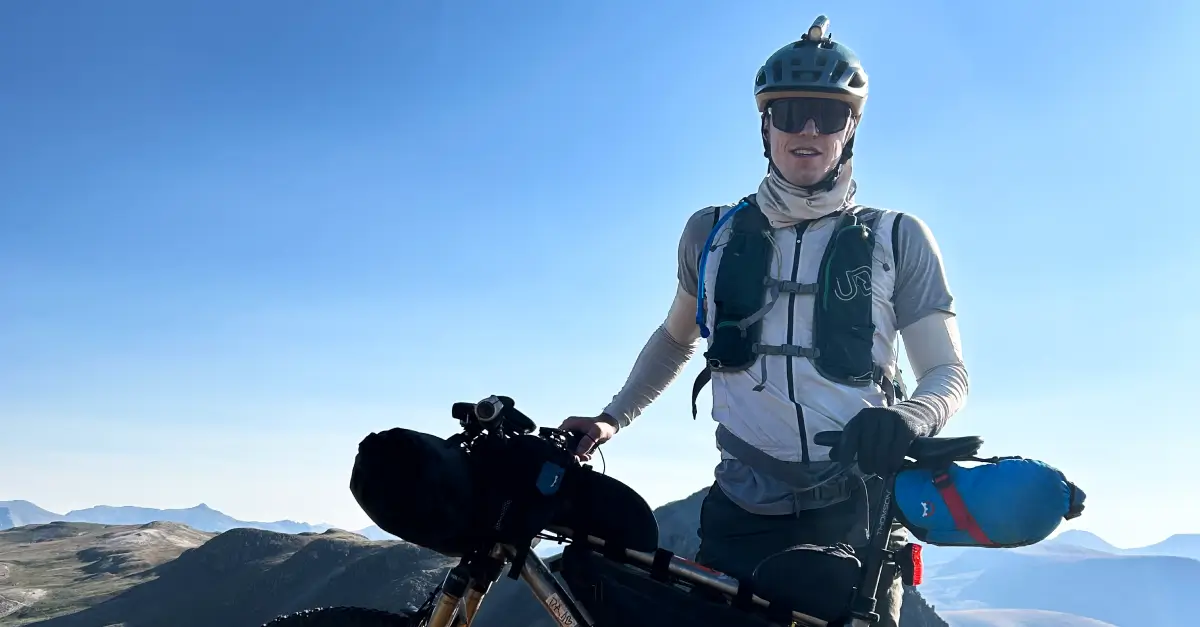
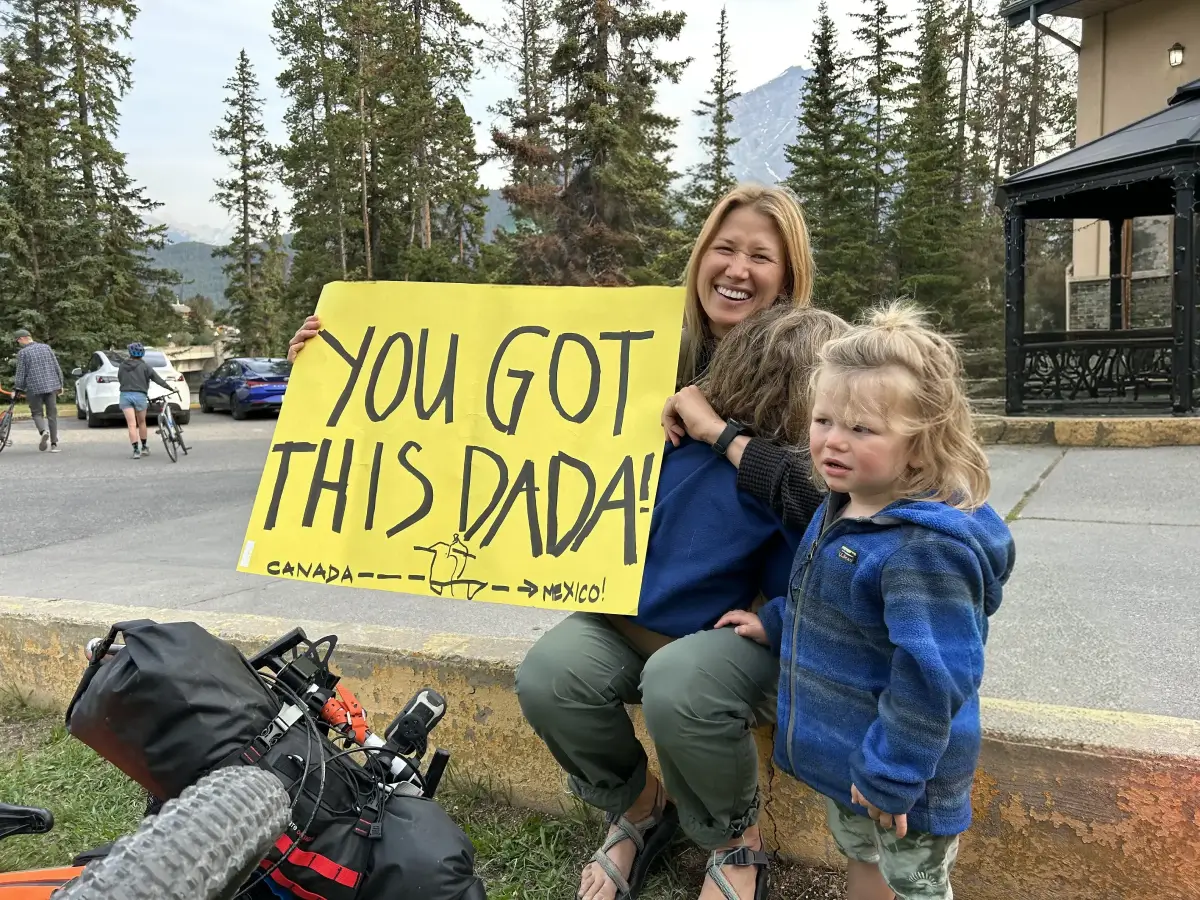
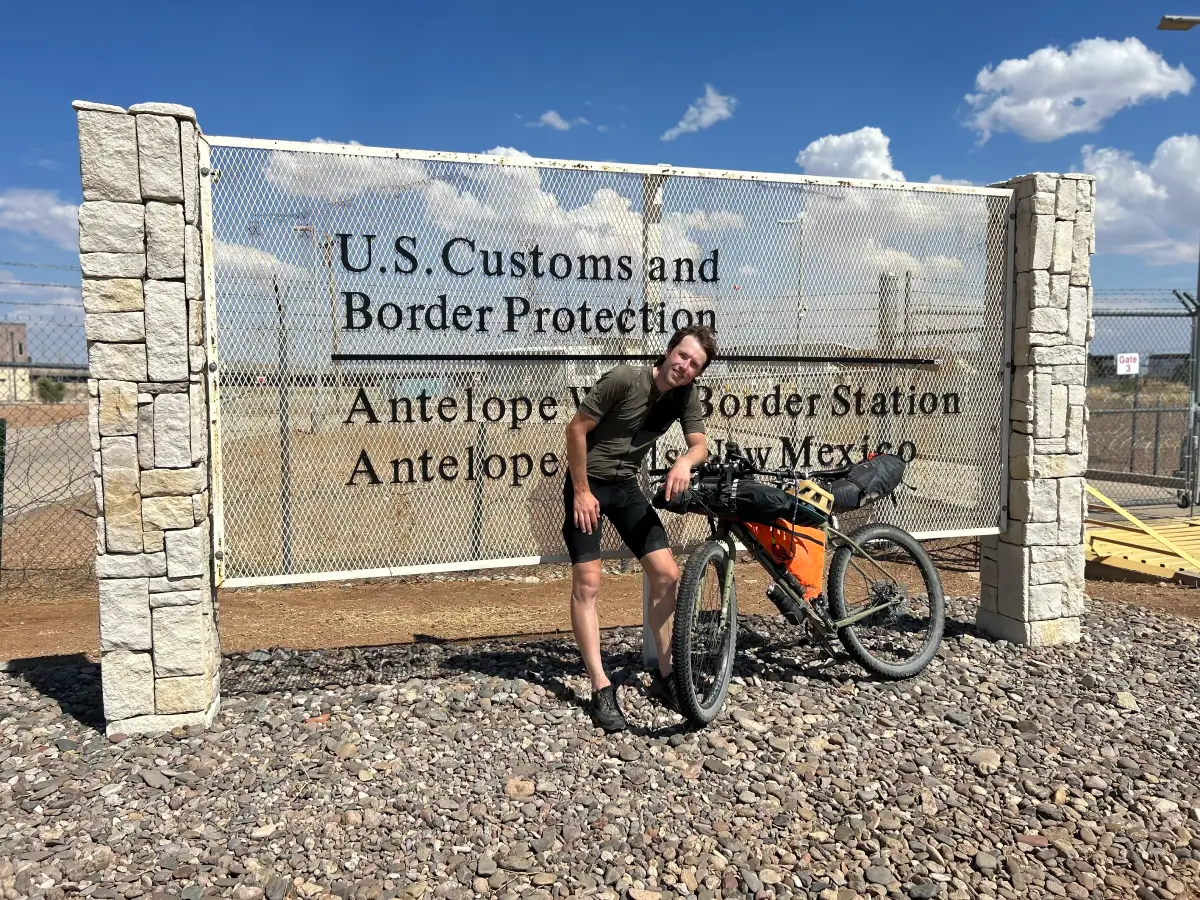
In 2023, my wife and two boys, then ages 2 and 4, dropped me off in Banff, Canada, with a bike and everything I would need to make it on my own to the Mexican border. Twenty-seven hundred miles and twenty-one days later, I completed the Tour Divide—a fully self-supported race spanning the length of the United States, with enough cumulative elevation gain to equal climbing Mount Everest seven times.
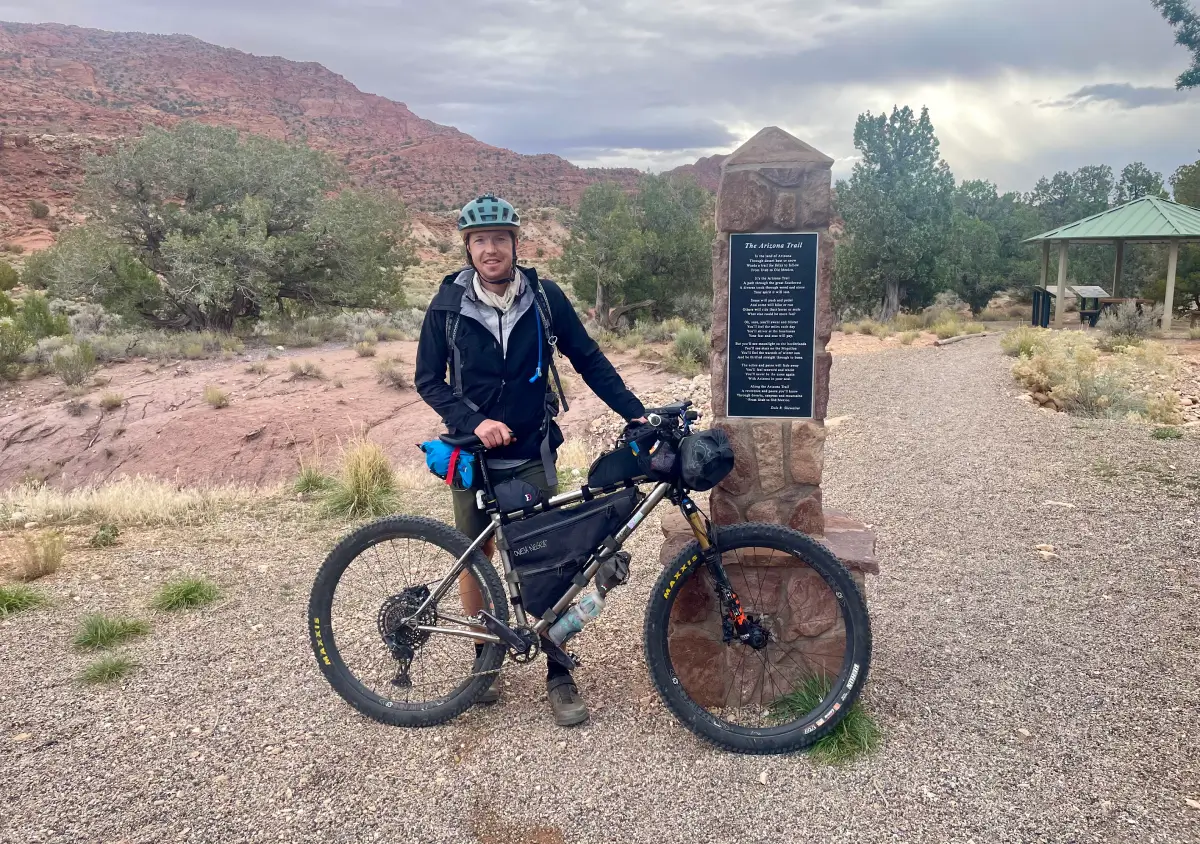
That led to the Arizona Trail Race in 2024, a rugged 800-mile trek through the desert that took 11 days and culminated in a rim-to-rim crossing of the Grand Canyon—descending thousands of feet to the canyon floor and climbing all the way back out with my bike and gear strapped to my back.
Then came the Colorado Trail in 2025 and 2026—the shortest of the three routes at 550 miles, yet the most elusive. Much of the route lives above 10,000 feet, climbing relentlessly over one high-alpine pass after another, with long stretches exposed to extreme weather and little margin for error. Two attempts, two did-not-finishes.
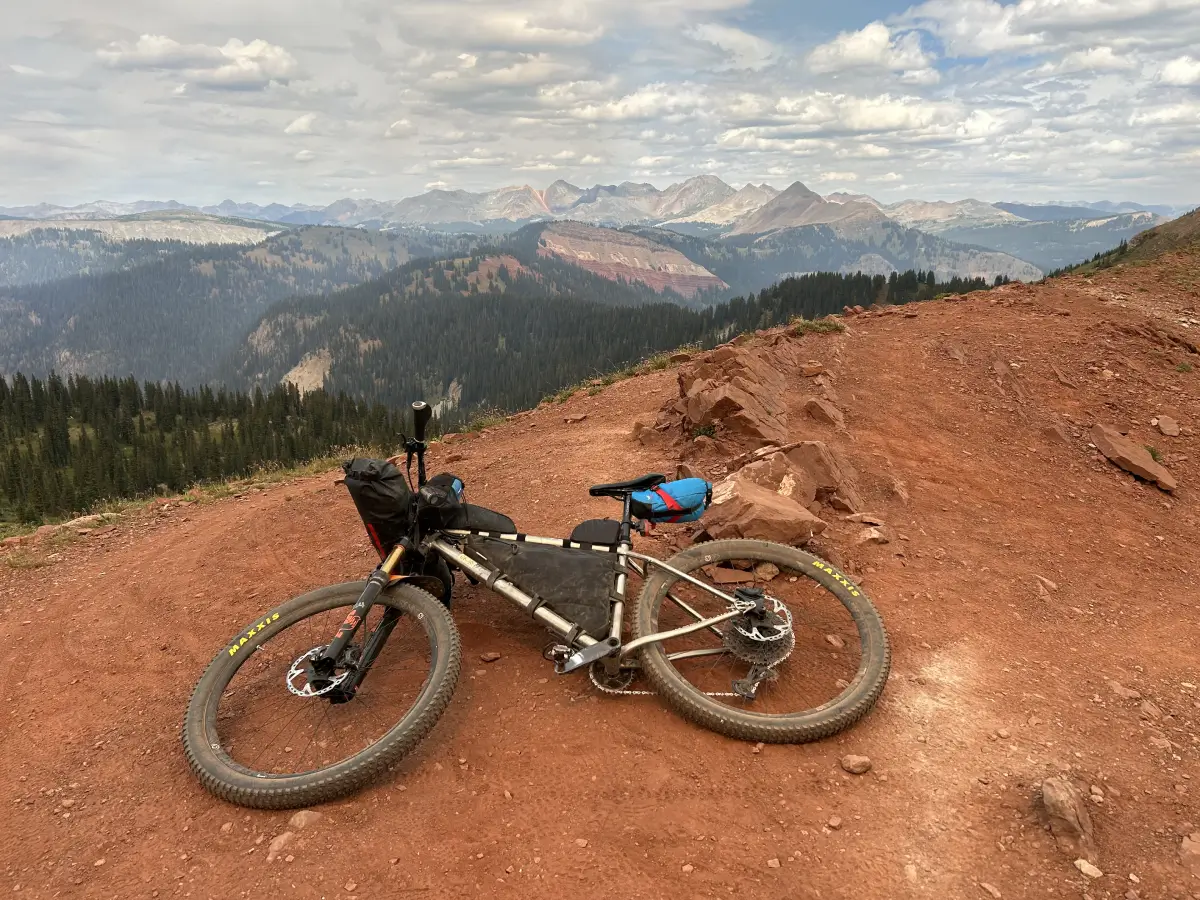
All told, I have ridden more than 4,000 miles, climbed over 400,000 feet, and spent more than 40 days racing on these rides. What began as a one-time challenge became a quest to complete all three, collectively known as the Triple Crown of North American bikepacking.
I have gotten used to the raised eyebrows when I try to explain why, four years in, this still captivates me. These rides are physically grueling, can be dangerous, and are well beyond any “healthy” dose of exercise. They demand enormous time — in training and on the route — away from family and work. They cover long stretches between reliable water, food, and resources.
A bike failure on the Arizona Trail that I couldn’t repair on trail forced me to hike 22 miles off route to the nearest town in search of a mechanic. In Wyoming’s Great Basin, an unexpected wind event left me without water in 80-degree heat. And then there was the mountain lion—a far-too-close encounter at dusk on the North Rim of the Grand Canyon that absolutely scared the hell out of me.
Many sections are technical and unforgiving—miles of rocky trail at high altitude—while others cross remote, barren desert. Success depends on relentless efficiency: carrying only what is absolutely necessary and continuing to move at all hours, usually late into the night by headlamp. Sleep comes in short stretches, even alone deep in grizzly country, with ultralight gear that saves weight at the expense of warmth. Temperatures can swing from 100-degree heat to freezing in a single day, while weeks of wind and sun leave skin cracked, blistered and bleeding. It is fair to ask: Why do this? Why is it fun? I have asked myself the same questions—usually around 4 a.m., alone, on a mountain pass.
I don’t have all the answers. But I have learned a great deal out there —lessons that have followed me off the trail and into the operations of HighCamp, how we serve our clients, how our team responds to challenges and pursues ambitious goals of its own. Here are ten of them.
Ten Lessons from the Trail
1. Chase a goal, and you find your best self.
I am at my happiest pursuing a goal with real uncertainty attached — my wife noticed this long before I did. Training kept me focused and motivated, and in many ways I enjoyed the preparation and journey more than the finish itself. But that state only appears when the goal is big enough and uncertain enough to demand it. A safe, guaranteed outcome doesn’t create the same level of focus. This goes for me and for our team. At HighCamp, we set goals that carry genuine stretch, because that is when I have seen our best work happen.
2. Experience helps, but it doesn’t exempt you from being a beginner.
Despite two decades of ultra-endurance experience in the mountains, I had never bikepack-raced before the Tour Divide. That background gave me the fitness and mental toughness to believe I could do it, but it didn’t teach me route-finding at 1 a.m., how to function on three hours of sleep, or how to fix a mechanical failure on the side of a mountain. I had to be a total rookie again, in public, in my mid-40s. That is an uncomfortable place to sit—but being comfortable with the uncomfortable is ultimately how knowledge is earned. By the time 2026 rolled around, thousands of miles on the trail had made those same situations familiar. This is true in our profession as well. Experience gives us a foundation, but growth requires being willing to admit what we don’t know, ask questions, make mistakes, and learn in real time. I want HighCamp to be a place where expertise is valued, but curiosity is valued just as much—and where being a beginner at something new is seen not as a weakness, but as evidence that we’re still growing.
3. Failure is data, not a verdict.
I have finished two of these races and failed at two — both on the Colorado Trail. The first attempt ended in extreme exhaustion: fever, no appetite, and the hard call to withdraw. The second ended when forest-fire smoke rolled in and I withdrew rather than risk lasting lung damage. Each time, I had to separate what happened from what it meant about me — which is harder than it sounds after you’ve told everyone what you’re doing and have taken time from your family to try. I keep treating the DNF as information for the next attempt, not a reason to stop. It is the same choice I ask our team to make after a missed goal: failure is always a learning opportunity, so long as you learn from it and keep moving toward the target relentlessly.
4. Self-doubt is a companion, not a stop sign.
Somewhere in the middle of the ride— alone, cold, and behind schedule — doubt shows up. It insists you won’t make it, that this was a bad idea, that quitting is the reasonable choice. I have learned that doubt is rarely a reliable narrator of your actual capability; it is simply louder at certain moments. The move isn’t to silence it, but to keep going and let the next sunrise reassess. Leading a business under uncertainty produces the same voice — and learning to hear it without obeying it is a skill you build one long day at a time.
5. Endurance is a muscle — train it.
Endurance, determination, and persistence are requisite qualities in any ultra-distance race. They are also invaluable life and career muscles that must be deliberately strengthened. There is something about lowering your head and focusing with total intensity to survive a physical goal that carries directly into everything else. These rides have strengthened those muscles in me and reaffirm the long-term goal-setting that is part of HighCamp’s unique vision.
6. Suffering sharpens focus and perspective.
At some point in every ride, it stops feeling like a bike race and becomes a primal exercise in survival. All energy narrows to the most basic needs: finding water, eating enough, sleeping enough to function, and keeping my body moving forward. Everything else falls away. When it’s over, life’s simplest comforts—a bed, a warm shower, ice cubes, air conditioning—feel like extraordinary luxuries. We absorb an enormous amount of noise in our lives and our careers. These rides have taught me how quickly that noise disappears when only the essentials matter, and how much easier it becomes to distinguish signal from distraction. Business is no different: there will always be noise. The challenge is identifying the few signals that actually move the business forward and having the discipline to focus on them.
7. You are never truly alone.
You ride mostly in solitude, but you cross paths with others on the trail and trade stories and hard-won experience. There is a remarkable community of like-minded people out there, each carrying their own story of overcoming something difficult. Each encounter is inspiring and motivating. That community is part of what keeps me coming back—a reminder that even the most individual pursuits are strengthened by the people around us. The same is true at HighCamp. We each bring different strengths, experiences, and perspectives to the table, and the best work rarely comes from any one person working in isolation. We learn from one another’s experience, lean on each other when the path gets difficult, and gain momentum from each other’s successes. Individual contributions matter, but when they are shared across a strong team, they compound into something none of us could accomplish alone.
8. Remote, wild places are worth seeking out.
Self-imposed challenges in nature let you see some of the most remote and beautiful places on earth, and I remain in awe of them. The sunrises and sunsets from high passes, the alpine rivers and lakes, the stars from the depths of the Grand Canyon – they all energize and inspire me to do more in open country. That same instinct—to seek out unfamiliar terrain rather than stay on the well-traveled path—is something I want us to bring to HighCamp. Building something meaningful requires a willingness to venture beyond what we already know works, to stay curious when the path isn’t obvious, and to pursue opportunities others might overlook. New territory inevitably brings uncertainty, but it also offers new perspective. Sometimes you have to get far outside the familiar to see what is possible.
9. The body and mind are capable of remarkable things.
I have learned more about my body on these rides than anywhere else. I know how far I can go without food or water, and I know that even in the bleakest moments, the body finds a way to recover and perform again the next day. The mind is often the first to sound the alarm at discomfort, but it can also be the key to moving through it. It is genuinely remarkable what the human body can do—and it makes me want to use it, test its limits, and protect it so I can keep experiencing more. I think the same is true of our capacity at work. We are often capable of far more than we assume, particularly when circumstances require us to adapt, learn quickly, or solve something we haven’t encountered before. At HighCamp, I want us to be willing to stretch beyond what feels comfortable and discover what we’re capable of—but also to recognize that sustained performance requires recovery. The goal isn’t to operate at our limits all the time. It’s to build the resilience and confidence to know that when something difficult demands more of us, we can rise to meet it.
10. My family is the real engine.
My kids are my single greatest motivation. The questions they ask, the way they tell their friends, the interest they take—it keeps me pedaling when everything else says stop. And none of it happens without my wife, who has supported all four attempts—dropping me alone at a starting line in a foreign country with two small kids in the back seat, then running the household through every ride. She’s picked me up and nourished my frail and beaten self back to health. The same is true at HighCamp. None of us shows up to work entirely on our own. Behind every person on our team are spouses, partners, and families whose support makes it possible for us to do our best work. Their contributions may happen outside our walls, but they are part of what we accomplish here. I’m deeply grateful for the people who support our team—and I never want us to lose sight of the fact that our successes belong, in some small way, to them as well.
Why I’m Sharing This
Some of the most valuable outcomes of these rides happen after I get home. The time and space away — fully unplugged from the business — give me room to reflect and return to work re-energized, with a clarity I rarely find at my desk. Several of our best ideas have come from on the trail. The ME stipend, which we rolled out to the team after the Tour Divide to support each person’s individual self-development, was one of them. Stepping away didn’t pull me away from HighCamp; it gave me a better vantage point on it. We’ve now had five team members take on something uncomfortable of their own in their personal lives, thanks in part to the ME stipend.
Just as important, these absences have forced me to entrust and elevate our team and leadership to run the business while I’m gone — and they have done a tremendous job. Stepping away is hard for any founder; it can feel like the one thing you are not supposed to do. But watching the team take ownership in my absence has reinforced my confidence in them and, in turn, their confidence in themselves. It has made HighCamp stronger and more resilient than my being there every single day ever could. A strong company isn’t one that depends on its founder. It’s one that can thrive without them.
My bikepacking story is still unfinished. The Colorado Trail is still there, and I still have so much to learn. If there is one thing I hope our team, our colleagues, and our clients take from this, it is simple: pick the goal that carries real uncertainty. Put your head down and keep moving toward it. There is no guarantee of success, and there shouldn’t be. The pursuits that ask the most of us are often the ones most worth attempting. There is tremendous opportunity in having the courage to begin, the willingness to fail, and the resolve to begin again.
About the Author
 |
Brad Burgtorf Founding Partner Brad Burgtorf founded HighCamp Compliance in 2017. He has over 20 years of experience advising private fund managers on regulatory and operational risks. |